
windows - List all files and dirs without recursion with junctions


Is there a native|portable tool that can give me a unicode or a system local-compatible list of all files and directories under a path recursively, without recursing into junction points or links, in Windows?


For example, the built-in dir takedown icacls commands run into an infinite loop with the Application Data directory (1).


EDIT I would like to be able to get a text file or at least an easy clipboard transfer as an output.


Answer


This was somehow a hard question. Even StackOverflow has only fancy solutions.
But here is a simple one for listing all files recursively without junction folder loops.


Use PowerShell and test each file if it contains the attribute "ReparsePoint"


function Recurse($path) {

$fc = new-object -com scripting.filesystemobject
$folder = $fc.getfolder($path)

foreach ($i in $folder.files) { $i | select Path }

foreach ($i in $folder.subfolders) {
$i | select Path
if ( (get-item $i.path).Attributes.ToString().Contains("ReparsePoint") -eq $false) {
Recurse($i.path)
}
}
}

$scriptPath = split-path -parent $MyInvocation.MyCommand.Definition
$outputlist = Recurse($scriptPath) | Out-File -Filepath .\outputlist.txt


  1. Paste the code into a text file and save it as PowerShell (.ps1) script

  2. Place the script inside your desired folder to list all files+folder recursively

  3. Execute the script with PowerShell. A new file called outputlist.txt at the same location will appear


Quick comparison between the Powershell script and a common batch command


powershell  - good, no indefinite loops
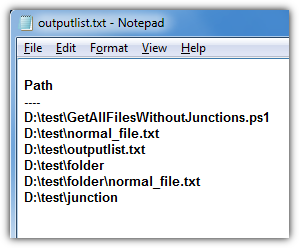
enter image description here


batch "DIR /B /S" - bad, indefinite loops through junctions points
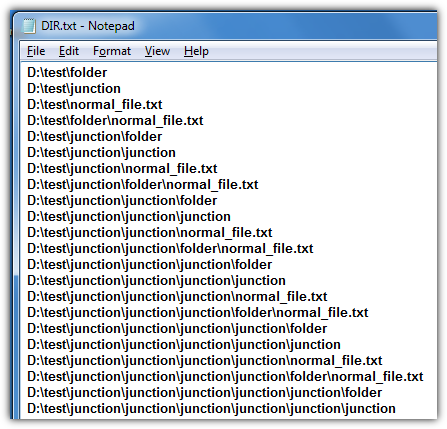
enter image description here


Comments

Popular Posts

keyboard - Is there any utility/method to change Windows key bindings to type rare chars to currently empty bindings?

I'm currently typing this post with my windows XP machine and (Spanish) keyboard, and I'd like to add some extra symbols to my text. I could open the "char map" windows utility, look for the desired symbols, and paste them. But I'd like something quickier. For example, when I'm using my OSX Mac at work, I can easily add a ©, ™, ® or similar symbols, just pressing some weird ALT-GR + G / H / J, key combinations. In my (Spanish) keyboard mapping, these combinations are empty, as they don't produce any char at all, which, on the other hand, is perfectly normal and desirable. So, I thought: Why couldn't I add some extra key mappings on top of my currently empty ALT-GR + G/J/H Keys in my Spanish keyboard, and thus, being able to quickly type these special symbols? So that's my question: Is there any utility/method to achieve that effect under windows? (My version is XP). I've even googled this for some time but no luck. I've been a long term Hot...

macos - Visit URL in running Firefox instance from command line in OS X

I have Firefox 3.6 installed on my OS X (10.6) box. I would like to open an URL in the running Firefox instance (in a new tab or window, no matter) from the command line. I tried several ways, neither switches -new-tab , -new-window , -url , or none helped me. I always get the A copy of Firefox is already open. Only one copy of Firefox can be open at a time. error message. Answer running open http://www.superuser.com from the command line will (at least for me) open a new tab to superuser.com in firefox (which is my default browser)

virtualization - How to select paravirtualization interface in VirtualBox?

Given a windows 8 host system (Intel Core i5) and a Linux Fedora host, I would like to determine the optimal setting for the paravirtual interface. Options are none Default Legacy minimal Hyper-V KVM This page suggest the selection is only based on the guest system: The biggest change in VirtualBox 5.0 is the introduction of paravirtualization support, bringing higher performance and time-keeping accuracy to supported guest operating systems (Hyper-V on Windows and KVM on Linux). Is that correct? Answer The VirtualBox Manual , in the section titled Paravirtualization providers explains very clearly when each should be used (emphasis added): Minimal: Announces the presence of a virtualized environment. Additionally, reports the TSC and APIC frequency to the guest operating system. This provider is mandatory for running any Mac OS X guests. KVM: Presents a Linux KVM hypervisor interface which is recognized by Linux kernels starting with version 2.6.25. VirtualBox's implementati...

How can I migrate a Windows 10 from BIOS/MBR boot to UEFI/GPT without reinstalling?

I've installed Windows 10 in BIOS mode and use MBR. How can I convert it to use UEFI and GPT without reinstalling Windows 10? Is this possible? Answer In Windows 10 v1703 (Creators Update, Build 15063), there is a tool called MBR2GPT.EXE included which does all steps . Best is to boot from a Win10 v1703 DVD/USB drive to the repair option (WinPE) and run Command prompt (cmd.exe) under repair options . Now use diskpart and list command to see all drives. X:\>diskpart Microsoft DiskPart version 10.0.15063.0 Copyright (C) Microsoft Corporation. On computer: Win10v1703 DISKPART> list disk Disk ### Status Size Free Dyn Gpt -------- ------------- ------- ------- --- --- Disk 0 Online 60 GB 0 B Now look or the disk number where your Windows is installed. This number is important for next step. Now run mbr2gpt /convert /disk:ID with the ID: X:\>mbr2gpt /convert /disk:0 MBR2GPT will now attempt to convert disk 0. If conversion is s...